
The BIG BLUE WAVE: Where Does the Blame Really Belong?
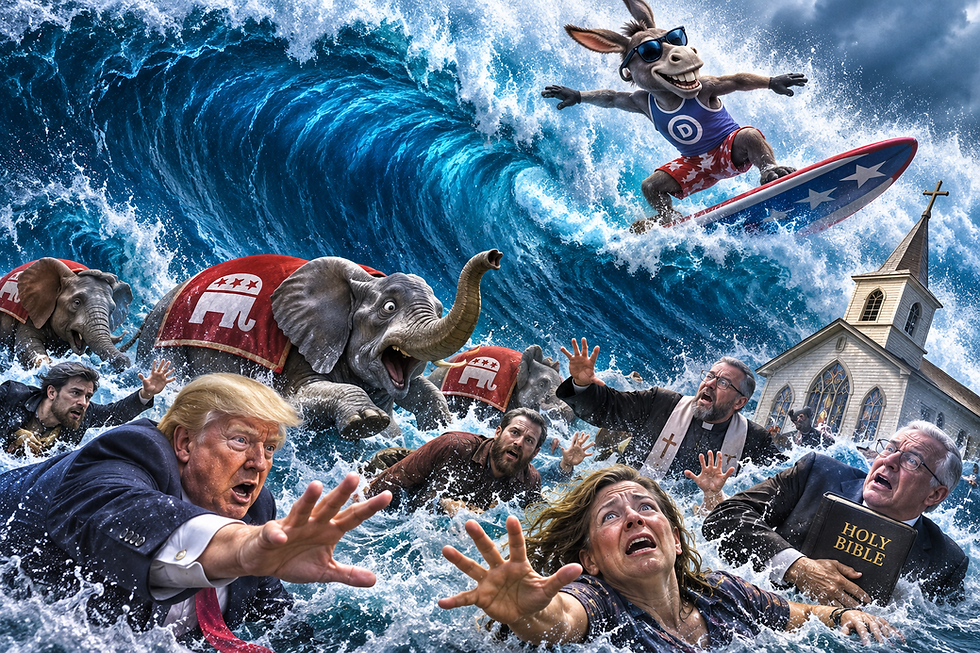
The Republican Party took a beating last night. A HUGE beating!
And I fear the consequences of this election will extend far beyond the next few news cycles. In my judgment, some of the policies that may follow will bring considerable suffering and hardship to the very neighbors Jesus commanded us to love. I sincerely hope I'm wrong, but I'm concerned that the consequences could last for years.
I'm disappointed. I'm frustrated. And yes, I'm angry.
But I'm also committed to remaining reasonable and following the truth wherever it leads—no matter what.
After last night's election results, I've been thinking about where the blame belongs. And I think there's plenty to go around.
Who Deserves the Blame?
Do I blame Donald Trump? YES!
In my judgment, his first term was—for the most part—very good. His second term, however, has been lackluster, to say the least. He seemed to be acting like a lame duck long before the election.
Now he actually is one.
He deserves blame.
Do I blame the Republican Party? Absolutely!
Republicans have too often failed to produce candidates who live up to the principles they claim to defend. Even when they possess political power, they frequently seem unwilling to exercise it with the conviction and determination their stated commitments would seem to require.
It's one thing to claim to oppose injustice. It's another thing to actually DO SOMETHING about it when you possess the power to make a difference.
So, yes, the GOP deserves blame.
For the record, I'm a registered Independent because I've been so dissatisfied with the Republican Party for a very long time. I don't owe the GOP my allegiance, and I'm certainly not interested in defending it simply because it has an "R" next to its name.
With that said, I regard the Democratic Party's current platform and policy priorities as a far worse alternative seeking to advance grotesque and satanic evils. That's why, as I've done in recent elections, I voted straight Red in the partisan races on my Nebraska ballot last night.
But please don't mistake my vote for an enthusiastic endorsement of the Republican Party. It wasn't.
I believe we have a moral obligation to oppose what we regard as the greater evil—in an effort to lessen the evils forced upon our neighbors—without pretending that the alternative is particularly good. And that's precisely why I'm so frustrated with the Republican Party!
We Need More ACTIVE Christianity!
But here's where my thinking goes a little deeper.
Who bears responsibility for the quality of the candidates our political parties produce?
We do. The voters—"We the People."
And that especially includes American evangelical Christians.
Christians are not merely passive spectators in the political process. We actually possess political power! We can actively participate in primaries, influence nominations, evaluate candidates, organize, speak publicly, and hold elected officials accountable.
And we don't merely do this with our individual votes—we do this with our VOICES! We need to speak up and use our circles of influence for the sake of truth and the good of our neighbors.
Yet too many Christians seem content to be passive and at most, just complain about the available candidates while neglecting opportunities to influence who those candidates will be. Indeed, too many who claim to follow Christ refuse to enter the political arena themselves.
There are far too many passive Christians. We need more ACTIVE Christianity!
The Left does such a great job of being “politically active.” I’m just asking those who claim to follow Christ to be theologically active in their private lives, in their public lives, on social media, and especially in the voting booth.
But too many Christians have seemingly given up. They're content to sit around waiting for the Rapture while the world around them deteriorates. They have lost their saltiness.
Now, don't misunderstand me. I'm looking forward to Christ's return as much as anyone. But anticipating His return is not an excuse for neglecting our present responsibilities. I hope Christ returns today, but for all we know, it could be a million years from now.
Don't presume Christ is returning tomorrow. Strive to make the world a better place NOW.
Jesus didn't command us to sit around waiting for Him to return while our neighbors suffer. He commanded us to love them in the here and now! We are called to be salt and light in this world (Matthew 5:13–16). The salt preserves and the light exposes the dangers hiding in darkness. Neither salt or light accomplishes its purpose by remaining inactive.
When Christians possess morally permissible and reasonably effective means of protecting their neighbors but refuse to use them without adequate justification, they're missing the mark (that means they are in sin). They're failing to fulfill an important aspect of the command to love their neighbors.
But I digress.
We cannot reasonably complain about the condition of our political institutions while refusing to take seriously our own responsibilities as citizens. Romans 13:1–7 teaches that governing authority ultimately exists under God's sovereignty. Now, think about what that implies for those of us living in the United States of America. In our constitutional republic, citizens possess a measure of political power through our votes and voices. We participate in determining who will exercise governmental authority on our behalf.
If God is sovereign over the governing authorities, as Paul teaches, then surely our participation in selecting those authorities is not somehow outside the scope of His sovereignty! And if we are morally responsible for how we steward the power and opportunities God has entrusted to us, then it follows that we ought to regard our political influence as something to steward responsibly before God.
That is to say, we possess real political power through our votes, however limited that power may be, and we bear moral responsibility for how we exercise that God-given gift. And because we still have freedom of speech, we also possess the significant power of our voices.
Use these voices to speak truth. Be loud about it. Always be reasonable.
These are God-given opportunities we ought not take for granted. We must steward them well and use them wisely.
But here's something else worth considering: People don't develop their moral convictions in a vacuum. Our beliefs, values, and judgments are shaped by those who teach us, influence us, and help us understand the world.
For Christians, that includes the men entrusted with teaching Scripture and shepherding the Church.
If Christians are failing to recognize or fulfill their moral responsibilities as citizens, shouldn't we at least ask whether those responsible for their spiritual and moral formation have adequately equipped them?
Where Are the Pastors and Elders?
That brings me to an even deeper question.
Why are so many Christians poorly equipped to think carefully about their political responsibilities?
This brings me to the group with whom I'm perhaps most frustrated:
AMERICAN EVANGELICAL PASTORS AND ELDERS!
Pastors, as a systematic theologian—and as someone who spent years serving as a pastor myself—I have a challenge for you.
Jesus commanded us to love our neighbors as ourselves (Matthew 22:39). He also taught that loving Him involves obeying His commandments (John 14:15). The Apostle Paul taught that the entire law is fulfilled in the command to love our neighbors (Galatians 5:14).
These obligations do not disappear when we enter a voting booth.
Our political decisions can have profound consequences for the neighbors Jesus commanded us to love. They can affect the vulnerable, the oppressed, the poor, children, families, and people whose rights and freedoms depend upon the decisions of those in power.
Surely Christian discipleship must include helping believers think carefully about these responsibilities.
Now please don't jump to the conculsion that I'm suggesting that pastors turn Sunday worship into partisan campaign rallies. Not at all! Nor am I arguing that every faithful Christian must agree about every candidate, legislative proposal, or political strategy.
I'm arguing for something far more fundamental.
PASTORS MUST NOT ALLOW POLITICAL CONTROVERSY TO BECOME AN EXCUSE FOR AVOIDING BIBLICAL MORAL TRUTH!
I once spoke with a pastor who refused to speak against abortion from the pulpit because he considered it a "political issue." I told him, "Your job is to teach objective North and South morality. If right and left politics gets caught in the crossfire, so be it!"
He saw things differently. We parted ways.
Sadly, I fear too many pastors see things differently. To say I was disheartened by that conversation would be an understatement.
However, there is still hope. Pastors who are willing to teach biblical moral truth—even when it becomes politically controversial—are still out there.
For example, I was so pleased with my pastor this past Sunday at City Light Church in Kearney, NE. This shepherd stood up from the pulpit and challenged his sheep to vote in this election. Moreover, he reminded us that Christians have an obligation to use their votes to lessen evil for the sake of the neighbors Jesus commanded us to love.
It was true. It was beautiful.
And it was exactly the kind of moral instruction Christians need to hear.
If your pastor consistently refuses to address the moral responsibilities Christians possess in public life, I believe that's a serious matter worth raising with him and the church leadership. Challenge your pastor respectfully. Ask your pastor why these issues are neglected. Encourage your pastor to teach the whole counsel of God.
In fact, feel free to share this article with him. 😉
And if church leadership persistently refuses to fulfill its biblical teaching responsibilities, it may be time to consider whether that church is faithfully equipping you for Christian discipleship.
What Makes a Man Biblically Qualified to Be an Elder?
And don't get me started about the lack of biblically qualified elders in the American Church today!
Actually, on second thought, let's talk about that for a moment.
What qualifies a man to serve as an elder? Is it his wealth? His business success? His popularity? His ability to make large financial contributions to the church?
Or is it his willingness to be a "yes man" to the senior pastor?
BY NO MEANS!
According to 1 Timothy 3:1–7 and Titus 1:5–9, elders must demonstrate godly character, spiritual maturity, self-control, integrity, and the ability to teach sound doctrine.
Paul explicitly states that an overseer must be "able to teach" (1 Timothy 3:2).
And Titus 1:9 makes the responsibility even clearer. An elder must himself hold firmly to sound doctrine so that he can both encourage others through sound teaching AND refute those who contradict it.
Did you catch that? Elders are supposed to possess the theological knowledge and ability to defend truth and correct error! This is not merely a position for successful businessmen who happen to have substantial financial resources.
Don’t get me wrong, there's nothing wrong with being a successful businessman, of course. Free Thinking Ministries would not exist if it were not for committed Christ followers who have made substantial amounts of money and then use those means to fuel ministry. But financial success is not a biblical qualification for spiritual leadership.
An elder is not merely a board member who oversees budgets, buildings, and business decisions. Elders are entrusted with shepherding God's people, guarding sound doctrine, and providing spiritual leadership.
How can a person guard sound doctrine if he doesn’t have sound doctrine in the first place? Being an elder requires theological competence!
Not every elder needs a PhD in theology or even formal academic training. But every elder should, at the very least, be a serious autodidact—a committed student of Scripture, theology, and sound doctrine who diligently seeks to develop genuine theological competence.
Indeed, I would argue that an elder ought to be sufficiently equipped to engage in a serious and intellectually responsible theological discussion with someone who possesses a PhD in theology. I'm not suggesting he needs to know everything a professional theologian knows or be capable of winning an academic debate. But he ought to be able to understand the issues, follow the arguments, reason logically, handle Scripture responsibly, and defend sound doctrine.
Speaking from personal experience, I am often shocked by how poorly equipped some church elders are when it comes to biblical knowledge, hermeneutics, theology, and basic logical reasoning. Frankly, it's frightening when men entrusted with guarding the theological integrity of an entire congregation struggle to demonstrate these fundamental competencies.
After all, a man is not magically endowed with theological knowledge simply because he gets voted into an elder's chair! Indeed, being appointed an elder doesn't make a man theologically qualified. He should already be theologically qualified before he's appointed!
Yet far too many men seem to be appointed as elders primarily because of their financial success, business experience, popularity, or other considerations that have little to do with the biblical qualifications for spiritual leadership.
Elders must be sufficiently grounded in Scripture and sound doctrine to fulfill the responsibilities Paul actually identifies. Moreover, the New Testament closely connects the work of elders with shepherding and pastoral oversight (Acts 20:17, 28; 1 Peter 5:1–3).
Bottom line: If a man cannot adequately understand, explain, defend, and apply biblical truth, why is he entrusted with overseeing the spiritual direction of an entire congregation?
And if pastors and elders themselves are poorly equipped to reason through moral and theological questions, should we really be surprised when their congregations struggle to do the same?
And let's not forget the warning James gives to those who would assume the responsibility of teaching God's people:
"Not many of you should become teachers, my brothers, for you know that we who teach will be judged with greater strictness" (James 3:1).
Think about that for a moment.
God holds those who teach His people to a higher standard of accountability!
Pastors and elders are not merely responsible for what they teach. They must also take seriously their responsibility to equip the Church with the truth necessary to recognize and resist error, exercise sound moral judgment, and faithfully obey Christ.
This is not a responsibility to take lightly!
If Scripture teaches that something is morally wrong, pastors and elders should be willing to teach that truth—even when doing so challenges prevailing cultural assumptions or the policies of powerful political institutions.
And teaching moral principles in a vague and abstract way is not sufficient. The sheep need clear teaching so they can learn how to actively apply those principles to the actual decisions they face.
That includes political decisions.
Pastors and elders should be teaching Christians to carefully examine policies, compare them to the Law of Christ, assess their consequences, recognize objective moral obligations, and exercise their political power responsibly.
The Law of Christ—Not Political Parties!
And we should be willing to challenge BOTH political parties when they fall short.
Let me be crystal clear: My ultimate goal is not merely a stronger Republican Party. It's a morally better Republican Party AND a morally better Democratic Party!
Yes, I believe that one party today is far worse than the other. One is bad; the other is much worse. So, don’t confuse my assessment of the current political landscape as a ringing endorsement of either party.
To put it bluntly, I think one party is deeply disappointing and the other is advancing policies that are grotesquely evil.
But political parties are not our ultimate standard of goodness.
The Law of Christ is!
Imagine a country in which Christians consistently held candidates in BOTH parties accountable to serious moral standards. Imagine if pastors and elders consistently equipped their members to think carefully, reason responsibly, and act courageously in public life.
In the words of MercyMe, "I can only imagine!"
Because right now, I believe much of the American Church is failing in this responsibility.
Love Is a Verb!
If pastors, elders, and church leaders would step up, our culture would look very different. But that kind of change requires more than complaining about election results every two years. It requires moral formation. It requires courage. And it requires Christians who understand that loving their neighbors involves more than merely expressing good intentions.
Love requires ACTION! As D.C. Talk once taught us: “Love Is a Verb.”
Remember the Parable of the Good Samaritan (Luke 10:25–37).
The priest and the Levite saw a suffering man and passed by. The Samaritan saw the same man and ACTED.
Jesus didn't present the Samaritan as an example merely because he possessed correct beliefs about helping people. He highlighted the Samaritan's practical—and active—demonstration of love. And then Jesus said, "Go, and do likewise" (Luke 10:37).
Jesus didn't just say, "Go, and merely THINK likewise." No, He commanded ACTION!
The parable illustrates a moral principle that certainly has implications for our responsibilities as citizens. Love is not merely something we profess. Love is something we DO!
There's a familiar saying, often expressed this way:
"Evil prevails when good men do nothing."
When people possess the power to oppose serious injustice through morally permissible and reasonably effective means, refusing to act without adequate justification can itself become a moral failure. And that's precisely why Christians cannot afford to remain passive.
We need pastors who are willing to teach the truth, the WHOLE truth, and nothing but the truth.
We need pastors and elders who teach the entire counsel of God (Acts 20:27), including its implications for how we live together as citizens.
PASTORS, PLEASE DON'T CONFUSE AVOIDING PARTISANSHIP WITH AVOIDING MORAL RESPONSIBILITY!
You don't have to become a political operative to teach your congregation how to reason biblically and theologically about political questions. But whatever you do, you should not assume that silence is the faithful alternative. If Christians are called to be both salt and light, then our moral convictions should have implications beyond the walls of our churches. And if we want a nation with better political leaders, we need citizens with better moral judgment.
That begins, in no small part, with the people responsible for teaching and equipping the church.
That burden falls upon the shoulders of pastors and elders.
The question is not merely whether the Church has something to say about the moral direction of our nation. The question is whether the Church is faithfully equipping Christians to understand and fulfill their responsibilities within it.
BOTTOM LINE: It's time for evangelical pastors and elders to take that responsibility seriously!
Not merely for the sake of the next election, the Republican Party, or the Democratic Party. But for the sake of the neighbors Jesus commanded us to love!
Stay reasonable (Isaiah 1:18; James 3:17),
Dr. Tim Stratton


Comments