
Who Has Bewitched You?: Libertarian Freedom, Propaganda, and the War for the Mind

Updated: Feb 5
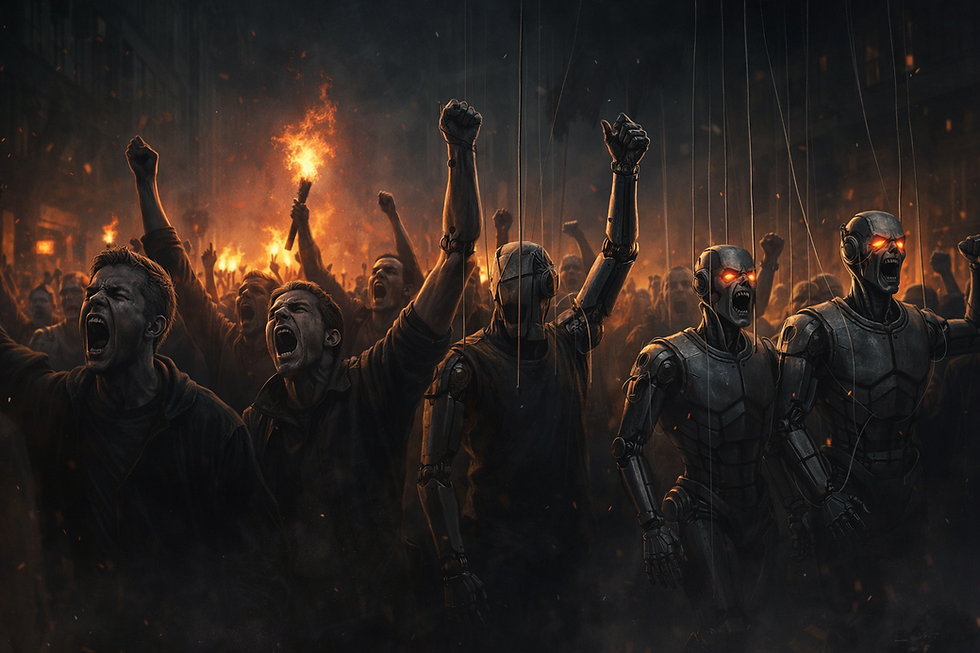
The apostle Paul once rebuked the Galatian church with a startling question:
“O foolish Galatians! Who has bewitched you?” (Galatians 3:1)
Paul was not suggesting that the Galatians had lost their free will or become metaphysical puppets. Quite the opposite. He was holding them responsible for allowing deception to take root—for failing to guard their minds against ideas that undermined truth and freedom.
In other words, Paul assumed that being deceived does not eliminate responsibility. In fact, it presupposes it.
That ancient rebuke feels uncomfortably relevant today. How do seemingly normal, intelligent people come to think, speak, and act in ways that appear irrational, ideologically possessed, or morally incoherent? How can entire crowds chant slogans, excuse violence, or repeat demonstrable falsehoods with near-religious fervor?
And perhaps most importantly: How do we explain this without abandoning libertarian freedom or collapsing into determinism?
I want to argue that libertarian freedom not only survives the reality of propaganda and mass irrationality—it explains it better than any deterministic alternative.
Influence Is Not Causal Determination
We should begin by clearing up a crucial confusion.
To say that rhetoric, propaganda, or social pressure influences people is not to say that it causally determines their actions. Influence presupposes agency. Deterministic causation eliminates it.
Propaganda does not work by overriding rational agency; it works by exploiting neglected agency. Lies persuade when truth is no longer primarily valued. Emotional manipulation succeeds when reason is willingly sidelined—when one fails to exercise proper care in how one is thinking.
In short, deception is a parasite on rational agency—it does not replace it (at least not immediately).
If human beings were merely causally determined by elites, algorithms, or rhetoric, then outrage at their actions would make little sense. Moral condemnation would be incoherent. Appeals to “do better” would be meaningless.
Yet we know that is not how reality works.
Libertarian Freedom Over Time
One of the biggest mistakes people make in these discussions is assuming that freedom must be exercised fully and equally at every moment in order to count as genuine.
That assumption is false.
Libertarian freedom is best understood diachronically—that is, across time.
Human beings freely choose habits of thought. Those habits shape both rational and moral character. And one’s character, in turn, constrains future deliberation. This insight is neither novel nor controversial.
Aristotle recognized it in his account of habituation, arguing that repeated voluntary actions form stable dispositions—virtues or vices—that later shape what an agent finds reasonable or desirable (Nicomachean Ethics, Book II). Aquinas developed this further, maintaining that freely chosen habits (habitus) can strengthen or weaken rational judgment over time while remaining grounded in voluntary agency (Summa Theologiae I–II, qq. 49–55).
Scripture assumes this framework throughout: hardened hearts (Heb. 3:13), seared consciences (1 Tim. 4:2), and eyes that no longer see or ears that no longer hear (Matt. 13:15) are not imposed from without, but arise from sustained resistance to truth.
People can freely choose:
• intellectual laziness,
• tribal loyalty over truth,
• outrage over understanding,
• ideology over evidence,
• emotion over rationality.
When those choices are made repeatedly over time, the result is predictable: the gradual erosion of rational freedom and epistemic responsibility.
This does not mean that later irrational actions are causally determined by someone or something else. It means that agents have become self-enslaved through earlier free—and poor—choices. Such persons might not be causally determined metaphysical puppets, but they are far easier to manipulate because they have surrendered the vigilance required to remain free thinkers.
Vladimir Lenin is commonly credited with the phrase “useful idiots” to describe those who unknowingly advance an ideological cause against their own interests. While the precise origin of the term is debated, the concept captures a real phenomenon: individuals who are not coerced against their will, yet are reliably controllable because they have freely abandoned intellectual self-governance over time.
Ordinary Men and the Path to Intellectual Captivity
This framework is illustrated powerfully in Ordinary Men, a book I encountered as a student in Clay Jones’s course on the problem of evil while he was still teaching at Biola University—a decision to let him go that remains deeply unfortunate, as he is one of the finest teachers I have ever had.
The chilling lesson of Ordinary Men is not that ordinary people were forced to become monsters against their will. It is that they became monsters by degrees—through freely chosen conformity, incremental moral compromise, and sustained self-deception over time.
The same pattern applies today.
Mass irrationality does not require science-fiction mind control. It requires something far more ordinary—and far more disturbing:
Free agents abandoning the discipline of rational self-governance.
Losing the Freedom to Think—By Misusing It
Here is the key claim, and it must be stated carefully:
There are many people today who no longer possess the freedom to think rationally in the moment.
But this does not mean:
• they were causally determined to become irrational, or
• they are exempt from moral or rational responsibility.
It simply means they misused libertarian freedom in the past.
They failed to guard their minds—though they could have done otherwise.
They stopped testing ideas.
They allowed falsehoods to settle in unchecked.
They permitted emotion to govern judgment.
Each step was voluntary. And together, they let bad thinking take them captive.
And now—tragically—those thoughts have taken them captive. This is precisely the danger Scripture warns us about.
Scripture and the Battle for the Mind
Paul writes:
“We take captive every thought to make it obedient to Christ.” (2 Corinthians 10:5)
And elsewhere:
“See to it that no one takes you captive through hollow and deceptive philosophy.” (Colossians 2:8)
Notice the tension—and the warning.
There is no neutral ground. Either we take our thoughts captive, or thoughts will take us captive. When we take our thoughts captive to obey Christ, we are “transformed by the renewing of our minds” (Romans 12:2).
This is why Paul frames the Christian life as warfare (Ephesians 6). The battlefield is not merely political or cultural—it is cognitive and spiritual (though it inevitably overflows into politics and culture). Our minds are made in the image of God, and they are therefore prime targets for deception. Scripture reminds us that our adversary is “the father of lies” (John 8:44), whose strategy has always been to distort truth, corrupt reason, and turn light into darkness.
But we are not meant to be passive victims.
We are called to be active warriors.
Propaganda, “Brainwashing,” and the Myth of Determinism
Some respond to mass irrationality by saying, “These people are just brainwashed. They couldn’t help it.”
Ironically, that response concedes far too much to determinism.
If people are merely products of their environment—causally controlled by propaganda—then moral responsibility dissolves. Appeals to reason become pointless. Repentance becomes unintelligible.
Libertarian freedom offers a better explanation:
People remain responsible precisely because they once had—and misused—the power to resist deception and think clearly.
This also explains why propaganda does not work on everyone. Two people can hear the same rhetoric, consume the same media, and reach radically different conclusions. Why? Because they are not machines. They are free agents. Some are not being as careful as they could have been (this is the epitome of libertarian free thinking).
Why Free Thinking Matters More Than Ever
This is the philosophical and theological foundation of FreeThinking Ministries.
The goal is not merely to win debates, but to train minds—to cultivate intellectual virtue, logical clarity, and spiritual vigilance.
We are witnessing the downstream effects of decades of neglected thinking:
• emotion replacing reason,
• slogans replacing arguments,
• certainty replacing humility.
Even within Christian philosophy, some thinkers who once did careful and admirable work appear to have surrendered intellectual discipline to ideological capture—failing to take thoughts captive and mistaking passion for insight. Indeed, some of my former heroes have fallen (and their legacy is tarnished).
None of us are immune. Neither am I.
That is why we must remain rooted in Scripture, committed to prayer, and willing to sharpen one another through reasoned and logical dialogue. Iron sharpens iron (Proverbs 27:17)—but only if we allow it to.
Final Thoughts
Paul’s question still confronts us:
"Who has bewitched you?"
Libertarian freedom does not deny the power of propaganda. It explains it. It explains how free agents can slowly surrender rational autonomy, why responsibility remains even when clarity is lost, and why the battle for the mind is one we must fight—intentionally and together.
Determinism explains none of this.
And if we fail to take our thoughts captive, we should not be surprised when someone else does.
“Come now, let us reason together,” says the Lord (Isaiah 1:18).
Stay reasonable,
Dr. Tim Stratton
Note: This article was inspired by a text conversation with my good friend and former classmate at Biola University, Timothy Fox.


Tim Stratton repeatedly implies some version of the following inference: we know reality isn’t deterministic; propaganda doesn’t work on everyone; therefore libertarian freedom must be the correct explanation. That is not a scientific inference. It is radically underdetermined. The fact that influence is not uniform across agents does not license the conclusion that libertarian free will is doing the explanatory work. At best, it shows variability under constraint. Yet the article treats this variability as if it were decisive evidence, when in fact it leaves multiple explanatory models equally viable.
This is the first and most consequential error: the epistemic logic of the piece relies far more on moral attribution than on empirical constraint analysis.
The problem begins with a…