
Tim Stratton's T.A.C.T.I.C.S.: Reasonable Triage vs. The Third Way

Updated: Dec 18, 2025
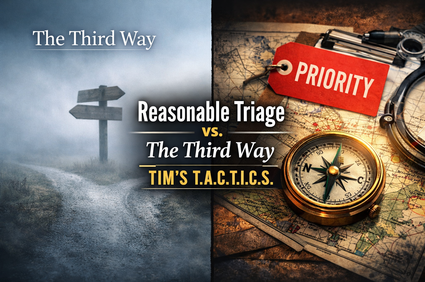
In recent years, many Christian leaders—most famously the late Pastor Tim Keller—have promoted what’s often called a “Third Way.” Keller’s idea was that Christians shouldn’t become pawns of either political tribe. Instead, we should resist culture-war polarization by emphasizing gospel-centered principles that critique the imperfections of both the Left and the Right.
There’s wisdom in that impulse. And I agree that the Kingdom of God transcends every imperfect human political party.
But, although there is no perfect political party this side of eternity, that doesn’t mean that each political party is equally imperfect. There are degrees of missing the mark—some political parties can miss the mark by miles while other imperfect political parties might miss the mark by inches.
Moreover, far too often, what’s branded as “Third Way Christianity” quietly morphs into moral paralysis—a refusal to name evil plainly for fear of sounding “too political.” In the real world, this often means that pastors coddle the Left and punch the Right.
I’ve experienced this firsthand when my wife and I were disfellowshipped from our church a year ago. It wasn’t because I denied an essential doctrine or sinned morally.
It was because I refused to stop speaking about the moral consequences of bad ideas—ideas that are destroying human lives, families, and freedoms. I was told my warnings about Marxism, radical gender ideology, abortion, and political deception were “too divisive.” Ironically, I wasn’t disciplined for false teaching—I was shown the door for telling the truth too clearly.
It was surreal. We were grieved. We had poured our hearts into that community of believers for nearly two decades, discipled people who we still love to this day, and suddenly found ourselves outside the very flock we tried to protect. But even in the heartbreak, God used it to clarify my calling: to stand firm, even when standing costs you everything.
And yes—it hurt. These were people we love (including the elders). But truth doesn’t stop being true just because it’s inconvenient.[1]
As I’ve often said, I don’t look for fights—but I am willing to fight for truth. And when truth is under siege, silence isn’t neutrality. It’s a surrender to evil.
Keller’s Third Way: Good Intentions, Fatal Flaw
Tim Keller’s vision of the Third Way was rooted in pastoral sensitivity. He wanted Christians to model the grace of Jesus toward sinners and the justice of Jesus toward the oppressed.
That’s admirable—and in theory, it’s beautiful. But in practice, Keller’s followers often ended up splitting the difference between good and evil, as though balance itself were a virtue like a yin-yang symbol.
Consider journalist Kirsten Powers, who spent well over a year at Keller’s prominent NYC evangelical church. She was pro-choice and abortion was a topic that was very important to her. But, she said that abortion “was never addressed from the pulpit,” and only after she was deeply involved in the church did she discover that Keller was personally pro-life—and so was the majority of the congregation.
She called this seeker-friendly “secretiveness” a red flag. Whatever the intent, the effect was confusion—and ultimately, she left. The “Third Way” didn’t pastor her. She rightly felt deceived.
My friend Dr. Joshua Farris recently observed that the problem with so much “Third Way” thinking is that it’s not truly peacemaking—it’s passivity disguised as nuance. It confuses timidity for wisdom and silence for balance.
The result isn’t a peace that passes understanding; it’s moral paralysis. When leaders blur ethical lines to keep everyone comfortable, they end up reinforcing the very evils they claim to transcend.
The “Third Way” easily becomes a theological Switzerland that tries to be neutral in the face of a moral war. But neutrality during the time for triage isn’t wisdom. Indeed, it’s incompetence. And Jesus wasn’t neutral. He didn’t split the difference between truth and lies. He spoke compassionately to the lost, yes—but He also called hypocritical religious leaders a “brood of vipers.”
When I see churches proudly calling themselves “apolitical,” what I often find beneath that label is fear—fear of controversy, fear of media backlash, fear of losing financial donors or members. Indeed, a church that strives to be “apolitical” almost always becomes the very thing it claims to avoid—a political pawn used by the worst of evils.
I get it. It’s easier to post safe Bible verses than to confront real evil. But the gospel was never meant to be safe.
Gavin Ortlund’s Concerns: A Brotherly Response
My friend Gavin Ortlund recently offered a thoughtful video reflecting on the backlash against “Third Wayism.” In fairness to Gavin, he’s not defending moral equivalency or cowardice. He explicitly says the Third Way—at its best—isn’t about splitting the difference between Left and Right, but about letting Scripture “rearrange the furniture” of our political assumptions and following Christ wherever His Word leads.
If that’s the definition, then count me in. That’s precisely how I operate. I left the Republican Party back in 2007 because I opposed issues surrounding the Iraq War and the Patriot Act. I even voted for a Democrat (Ben Nelson)—and later regretted that vote. I’m not a party man; I’m a Scripture man. I’m still registered as an Independent, and I’ve criticized the Right for years when they’ve deserved it. In fact, although I do not consider Nick Fuentes to be “on the right” in any meaningful sense, many people do. For that reason, I have publicly condemned him and his ideology as morally evil and incompatible with Christianity. Christians ought to have nothing to do with him.
So what’s the difference between me and many “Third Way” pastors? One word: Application.
In practice, the Third Way has often functioned as silence where clarity is most needed. It has become a posture that treats unequal evils as if they’re symmetrical—when they aren’t. It’s not 1992 anymore.
In 2025, the sheer gravity and scale of the Left’s platform—abortion on demand, the sexual mutilation of confused minors, males in women’s spaces, open borders, soft-on-crime policies, pro-Hamas sentiment, and an openly Marxist moral framework—create a moral emergency. This is a time for reasonable triage.
Triage is the assessment of patients or casualties in order to determine the urgency of their need for treatment. When triage is required, refusing to name the largest hemorrhage is sinful negligence.
Gavin warns against the “no enemies to my right” mentality. Fair point. Believe me, as someone who left the GOP years ago, I know there are enemies (and errors) on the Right. But triage means you deal first with the bleeding that kills. Prioritization is not partiality; it’s wisdom.
Moral judgment needs categories like proportion, proximity, and probability of harm. If one side is enshrining policies that directly destroy life and family, that is the immediate threat that love of neighbor compels us to confront. After the house fire is out, by all means, let’s repaint the trim.
This is also where reasonable triage helps us think clearly about political leadership. Take President Trump as a case study. His social media presence—especially on Truth Social—has often been appalling, undisciplined, and embarrassing. Those things matter, and they should not be ignored or excused.
But moral triage does not tell us to treat every moral failure as equally grave. It tells us to rank them honestly. A crude tweet and a destructive policy are not the same kind of moral evil. Advancing policies that protect life, preserve families, restrain tyrannical regimes, and safeguard national sovereignty carries far more moral weight than tone-deaf or immature online rhetoric.
In a fallen world, it is better to have a strong leader who advances objectively loving and life-preserving policies—even if he is the worst tweeter of all time—than a polished communicator whose policies quietly destroy human lives (as we've seen with the destructive policies of G.W. Bush, Obama, and Biden). Triage doesn’t blind us to faults; it helps us see which ones are bleeding us dry.
Gavin also urges historical perspective—citing C. S. Lewis as someone who wouldn’t fit today’s partisan molds and who would be attacked by both conservatives and liberals. But this is a category mistake as one can hold a theologically liberal view (like God created via evolution) and still be “politically conservative” because he understands the Law of Christ. For example, Lewis’s debates—about evolution, inerrancy, and similar questions—were primarily intra-Christian theological disagreements.
Lewis landed to the left of some of his interlocutors on these theological topics. The disputes dominating 2025, however, are civilizational moral questions impacting immediate victims with life and death consequences. “How old is the earth?” and “Should we mutilate the genitals of confused children?” are not the same kind of question.
It’s telling that the seeming majority of Christians who disagree with me on Molinism vs. Calvinism, free will vs. determinism, young-earth vs. old-earth, pre-trib vs. post-trib, spiritual gifts, baptism—you name it—stand shoulder to shoulder with me when it’s time to confront the extreme, destructive, and evil policies of the modern Left. That unity across deep theological lines is itself a signal: we recognize a common enemy of human flourishing.
Finally, Gavin mentions believing in climate change. Okay—then the prudential questions follow: to what extent, at what speed, with which tradeoffs, and with what evidence of policy efficacy? Is this at the level of Al Gore’s imminent-doom alarmism? Or is it a long-horizon challenge that can be prudently addressed after we stop the more immediate moral bloodletting?
Again: reasonable triage. Christians are called to love their neighbors in the concrete, not in the abstract. That means ranking threats honestly and acting accordingly.
The Tragic Irony
Gavin asks that Christians stop “going for each other’s throats.” Fair enough—but the tragedy is that evil itself is already at our throats. The modern Left is literally choking the life out of the innocent: murdering babies before they can take their first breath, mutilating the bodies of confused children, and unleashing waves of lawlessness that make our streets unsafe.
“Soft on crime” policies allowed violent offenders back onto the street—one of them stabbed Iryna Zarutska in the throat. And a “tolerant” activist culture that celebrates rage against the righteous gave permission for a gay trans furry-activist shooter to put a bullet through Charlie Kirk’s neck.
So, no—Christians calling for moral clarity are not “going for your throat.” We’re pleading for those with influence and large platforms (like Gavin and other pastors and YouTubers) to use their voice while there’s still breath left to speak. Don’t mistake urgency for hostility, or moral clarity for cruelty. The wolves are real, and silence is complicity.
Yes, both political sides—and all human leaders—are imperfect. But equating their flaws is moral blindness. Karl Marx and George Washington were both sinners; but one’s ideas built a free nation, and the others ideas have enslaved and murdered over 100 million humans. Discernment requires proportion. We must not confuse imperfection with equivalence.[2]
So to Gavin I say: brother, thank you for calling us to charity, patience, and careful speech. I’m with you there. But grace does not mean silence or brushing off the evil of the Left by saying “well, both sides are imperfect”—especially when wolves are in the nursery.
Courage and charity are two sides of the same Christian coin. Let’s remain gentle with the wounded and winsome with the lost—but let’s also raise our voices and bark loudly when wolves come through the door—or when we see them stalking toward it.
When Strong Words Are Loving Words
Speaking of wolves and other animals, some have criticized me for referring to those advancing Marxist ideology as “Marxist rats.” They say it’s uncharitable or “dehumanizing.” But I’m not attacking anyone’s humanity—I’m describing the evil methods of these humans. Rats infiltrate, infest, and infect.
And that is exactly what Marxism has done—often in alliance with other anti-Christian systems, such as Islamist political movements governed by Sharia law, which are logically incompatible with the Declaration of Independence, the U.S. Constitution, and the Law of Christ—by burrowing into academia, media, government institutions, and yes, even segments of the evangelical Church.
Jesus used similar language. He called certain leaders “vipers.” John called deceivers “antichrists.” Paul quotes a pagan poet calling certain men ‘evil beasts’ (Tit. 1:12–13), and Peter warns about ‘irrational animals’ (2 Pet. 2:12). Jesus even called Peter, “Satan” right to his face (Matt 16:23)! None of these were slurs born of hate—they were metaphors born of love. They were warning sirens attempting to protect the Church from evil.
If I shout, it’s not because I hate you—it’s because I love you too much to watch you drive off a cliff to your own destruction. If my son were heading for a bridge that was out, love would compel me to scream, wave my arms, maybe even tackle him to the ground. Love protects—even when it doesn’t look “nice.”
Strong speech isn’t un-Christlike when it’s aimed at protecting others—because “love always protects” (1 Cor. 13:7).
Too many pastors today confuse kindness with cowardice. They quote “love your enemies” but forget that love sometimes raises its voice. As one who also worked security at my former church, if a wolf enters the nursery, the sin isn’t barking too loudly—it’s failing to bark at all.
The Shepherd’s Duty and the Sheepdog’s Role
When Jesus told Peter, “Feed my sheep,” He wasn’t talking about handing out spiritual candy—sweet sermons that make us feel good but leave us malnourished. He was commissioning Peter to protect the flock—spiritually, morally, intellectually, and even physically when possible.
A pastor who refuses to warn his people about evil ideologies, unjust policies, or deceptive leaders commits pastoral malpractice. He’s like a lifeguard who won’t blow the whistle because someone might be embarrassed.
We live in a cultural moment when evil parades itself as virtue and demands applause. To call sin “sin” is now branded as hate speech. To call Marxism “evil” is deemed unloving. But love without truth isn’t love at all. We need one hundred percent of both (and a few other things).
That’s why I’ve adopted what I call The Stratton Approach—reason and conviction in the service of love.
The Stratton Approach
1. Reason Over Rhetoric
Every claim must be justified. As I often teach, true belief + justification = knowledge. Assertions without reason are irrational noise. My goal isn’t to “own” anyone; it’s to reason with them (Isa. 1:18) for the sake of truth and for their ultimate good.
2. Love in Action
Love isn’t emotional approval—it’s willing the objective good of the other. Sometimes that means comforting the afflicted. Sometimes it means afflicting the comfortable.
3. Courage in the Face of Cowardice
The Church’s witness isn’t weakened by those who speak too boldly. It’s weakened by those who refuse to speak at all. Silence in the face of evil is complicity.
4. Truth Over Tribe
I am not committed to any political party—I am committed to the Logos (John 1:1). Truth has no party, but it does have direction. If my theological convictions align with one side and oppose the other, it’s only because truth happens to live there on that issue—not because my loyalty does.
As I once told a pastor who was practicing the “Third Way”:
“Your job is to teach objective North and South morality; if Right and Left politics get caught in the crossfire, so be it!”
This is why I’ve argued that no informed and consistent Christ follower can, in good conscience, align with or vote for the modern-day Democratic Party. That does not mean the Republican Party is the Party of Christ. It simply means that, in this moment of history, given what the modern Democratic Party now champions, faithful Christians ought to forcefully oppose by voting Red at the ballot box—not because Republicans are perfect, but because truth and human dignity are at stake.
My loyalty isn’t to elephants or donkeys—it’s to Aslan, the Lion of Judah.
None of this means we ignore character. Integrity matters. But moral leadership is more than tone and tasteless tweets—it’s direction. A flawed and uncouth captain steering passengers toward safety is far better than a polished liar steering them toward the rocks. The point isn’t to sanctify any politician; it’s to safeguard the image-bearers their policies affect. Christians aren’t called to worship politicians—we’re called to use prudence, restraint, and courage in a fallen world where no choice is spotless.
5. Hope in Christ Alone
My fight isn’t against flesh and blood. It’s against lies, powers, and principalities (Eph 6:12). My ultimate hope isn’t in elections or policies—it’s in the returning King who is both Truth (John 14:6) and Love (1 John 4:8) incarnate. With that said, to love thy neighbor is to do your best to protect thy neighbor.
Hope in Christ doesn’t mean passivity; it means perseverance. Our confidence in the King’s return fuels courage, not complacency. We stand firm precisely because we know how the story ends. The Lion of Judah will right every wrong—but until that day, His people are called to resist evil, defend the innocent, protect our neighbors, and shine light in the darkness. Hope isn’t an escape hatch—or a license to grow lazy and give up—it’s marching orders.
Indeed, it’s because of our reasonable hope that we fight. We may lose battles, but we cannot lose the war—for the outcome has already been secured. So stand firm. Fight with truth, courage, and love.
Bottom line: None of this absolves Christians of the call to repentance, humility, or love for political opponents as persons made in God’s image. Love the person; expose the lie.
Conclusion: A Better Way than the Third Way
I don’t reject everything Keller taught. His emphasis on humility, civility, and gospel centrality remains admirable—and his grasp of apologetics as a pastor was better than most. But a church that only whispers objective moral truth will eventually lose the ability to speak the truth at all.
We don’t need a Third Way that splits the difference between conviction and comfort. We need a Better Way—a way of backbone and compassion, of reason and righteousness.
That’s The Stratton Approach: Reason, Love, Courage, Truth, and Hope.
Speak the truth. Defend the truth.[3]
Love people enough to tell it—no matter the cost.
Stay reasonable (Isaiah 1:18),
Dr. Tim Stratton
“Have I now become your enemy by telling you the truth?” – Galatians 4:16
Notes
[1] To be clear, I have forgiven the church elders for their actions. I do not hold anything against them. I harbor no bitterness. I do not mention this story in an attempt to hurt them or the church. I simply share this story so that others can learn from it.
[2] Historians estimate that Marxist or communist regimes have killed between 80 million and 150 million people through executions, forced labor, famine, and political repression. The Black Book of Communism The Black Book of Communism (Harvard University Press, 1999) places the number near 94 million, while political scientist R.J. Rummel estimates between 110 million and 148 million deaths caused by government democide.
[3] After reading my article, Lee Nauman was inspired to create the following acronym (it was too good not to share). Consider T.A.C.T.I.C.S. — The Stratton Approach in Action:
T — Triage with Truth and Reason
In a world of moral chaos, prioritize the battles that matter most. Assess with wisdom, apply logic, and address the most urgent evils first—because neglecting the hemorrhage is negligence.
A — Action Rooted in Biblical Love
Love isn’t passive approval; it’s the active will to seek another’s good (“Love Is a Verb”). That means taking action when possible to oppose evil, defend the innocent, and advance truth—for the sake of objective biblical love.
C — Courage in the Face of Cowardice
Silence in the presence of evil isn’t gentleness—it’s complicity. Speak the objective truth with conviction and compassion—even in the face of fear.
T — Truth Over Tribe
Loyalty belongs to the Logos, not to elephants or donkeys. Let Scripture set the compass, not party lines. Accordingly, stand with the Party that is closest to truth.
I — Informed Insight Before Indignation
Slow down. Seek knowledge and understanding. Become informed before making judgments. Let information and discernment guide your response.
C — Consistency in Christ Over Complacency
True hope produces action, not apathy. Following Jesus means daily obedience—staying steadfast in truth, love, and integrity even when the world grows cold. Faithful Christians keep showing up, speaking up, and standing firm until the Lion of Judah returns.
S — Supernatural Dependence in Every Situation
Prayer fuels wisdom and power. Every battle is spiritual; every victory begins on your knees.


Comments