
Do stories have essence? Using God of War to explore the nature of ‘things.’

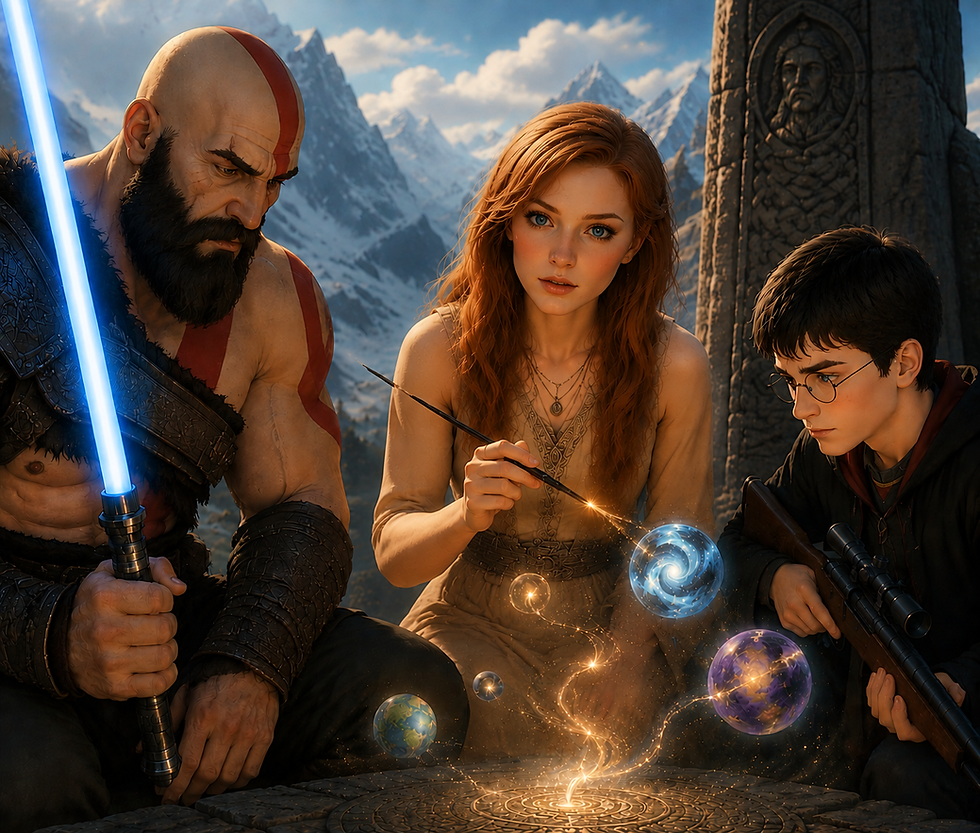
In one of the very few articles I’ve published, I argued for the merits and beauty of God of War 2018.[1] I played the HD remasters of the first two almost 20 years ago, the PS3 ports of the PSP versions, God of War 3, Ascension, and Ragnarök in addition to the 2018 game. So you get the idea, I’m a fan of this series.
Last week Sony announced that for the first time, the next game in the series will not feature Kratos as the main playable character but will shift focus to his second wife Faye. This will be God of War: Laufey. And because the internet exists and this is 2026 everyone started arguing about it in bad faith and accusing each other of being too woke, snowflakes, and/or misogynistic.
But behind all these accusations there are some good faith arguments that are philosophically interesting. Can a story or series change so much that it is no longer the same thing? I’m also a fan of Star Trek, but not the current modern iterations of it as I’ve found them to be almost universally terrible. Is this just my own subjective preference, are the current makers of Star Trek incompetent hacks who are completely incapable of telling good stories, did Star Trek change so much that it lost its ‘essence,’ or is it a combination of all three? If there is a point where I can say “that’s just not Star Trek” where is it and how do I justify that claim?
As a different example, my wife is a big fan of Harry Potter. As a thought experiment I once asked her if another Harry Potter book was published but in this one the characters fought each other with firearms and lightsabers, would that still be a Harry Potter story? She said no, that that sounds more like fan fiction.
Philosophy has a long history of asking and exploring this type of question, just typically not about stories and other media. So if we are going to argue and proceed in good faith it seems to me that the appropriate question to ask is if the God of War series has an essence, and if it does, does removing Kratos as the lead character violate that essence? If the answer to both questions is yes, then whatever God of War: Layfaye is, it’s simply not a God of War game. And this is obviously applicable to every other story and series as well. Is there a departure point wherein we can say, that’s just not God of War, Star Trek, Harry Potter, Star Wars, etc? It seems to me that behind many of the complaints fans have of the modern iterations of these series something like this idea is lurking. They are arguing that, yes modern Star Trek doesn’t have the essence, spark, or substance (Aristotle’s term for something like essence) that the original Star Trek series had and so it’s not Star Trek anymore.
There is an idea here that everything has a property or properties that are essential to it, such that if you change it or them, that thing is simply no longer itself. These types of properties are thus essential or necessary properties.
So to explain, I’ve argued several times before that I, Phil Kallberg, have an essential property of being the first son of my parents. The reason is pretty obvious with a little reflection. If you somehow change this aspect of me, the change would be so great that I would effectively be a different person. Change me from the first son of my parents to the first daughter of my parents and my life experiences, biology, perspective, and many other things would be so different that it just wouldn’t be meaningful to refer to me as Phil Kallberg anymore. I would just be a different person. And the same follows if you change who my parents are, or make me the fourth born instead of the first, and so on.
I’ve presented essays talking about issues regarding essence, personal cores, and substance before.[2] And it’s quite easy to find other more technical terminology that refers to this idea, but the terminology here isn’t really that important.[3] What matters is the basic idea. There is a thing or collection of things/properties that make me, me. If you change them, I’m simply no longer me. It’s quite easy to see how this idea can be applied to stories, series, and franchises. There is something that makes Harry Potter stories, Harry Potter stories, and if you change that they just are not Harry Potter stories anymore.
This idea of a type of essentialism makes sense to me, and I think it’s correct or on the right track. It also seems to me that it’s the commonsense view as I suspect that most people would just intuitively recognize that there is some point of departure wherein that other person is just not me anymore, that new TV series is just not Star Trek, and so on.
The main trouble here is determining what essential property or properties are. Not only is it often not immediately clear, it’s often pretty difficult to narrow it down. What makes a God of War game a God of War game as opposed to some other violent action game? Are there things other than the name Star Trek, concepts like the Federation and Star Fleet, that make Star Trek, Star Trek?
And I think this is the best, and probably the most common, objection to essentialism. If we cannot say what things are essential, then what good is this theory?
Aristotle and Edith Stein both attempted to get around this problem by negative definition. Take a property away, and if the thing remains itself, that wasn’t an essential property. If changing or removing the property makes the thing in question not itself anymore then that is an essential property. As Stein explained;
We find not only that the categorical structure of the soul as soul must be retained, but also within its individual form we strike an unchangeable kernel, the personal structure. I can think of Caesar in a village instead of in Rome and can think of him transferred into the twentieth century. Certainly, his historically settled individuality would then go through some changes, but just as surely he would remain Caesar.[4]
You can change the properties of where Caesar is located and what time he is in, and he remains Caesar, therefore those are not essential properties. His “unchangeable kernel, the personal structure” remains.
Now while I argue that Stein’s test can point us toward essential properties, and this is what I did with the above example about myself, it’s still the case that for many things we do not and probably cannot know what the exact essential property is. There is a vagueness problem where the point of departure is unclear. A Harry Potter book with firearms and lightsabers is too far, but what if it’s ‘Harry Potter’ story where the muggles use firearms and one of the characters is a fan of movies and happens to be watching Star Wars? It seems pretty clear to me that even if J.K. Rowling wrote a ‘Harry Potter’ story where Harry Potter assassinated people with .50 caliber Barrett rifle, we can say that’s just not Harry Potter. However this is a pretty extreme example. Where is the departure point? It’s not clear.
Good faith arguments on the other side can focus on this, as Bertrand Russell said of Aristotle's theory of substance, “Substance . . . is a concept impossible to free from difficulties. A substance is supposed . . . to be something distinct from all its properties. But when we take away the properties . . . we find there is nothing left.”[5] Aristotle’s version of the theory was a bit different than Stein’s in that he argued that substance is what remains when all properties of a thing are removed. He thought this was necessary as a change must act upon something and if the properties can change it cannot be one of them. So as Russell explained, it turns out when we take the properties away, to see what substance is, there's just not anything left. Thus substance is kind of a nonsense theory. And even though Stein’s version is better a very similar criticism applies.[6]
There are a significant number of serious philosophers who reject essentialism. And usually for reasons that are pretty similar to what Russell articulates or the problem I described. It's just often unclear what is essential, and what’s not. And in the cases where we can point to something that likely is essential, we get there in an odd way, like through negative definition.
So proponents of God of War: Laufey could adopt an anti-essentialism view and argue that there really is nothing essential about God of War games. It's just a title that Sony's slapped on some games to make money. And if the developers want to change the lead character, so be it. There is nothing essentially (God of War)ish.
Now my counter argument is that if there is nothing essential about anything and essential properties just don't exist how on earth can I group together the Harry Potter novels and say these belong together? Or anything at all? As a more practical example, it seems to me quite clear that trees as a collective group exist. And this group is composed of all the individual trees that exist. However; the reason I can group all these trees together is that they share whatever that essential property is that makes them all trees. It seems quite clear to me that virtually everyone else and I will struggle to give a complete analytic definition of what that essential property is. But if it's not there, how on earth can I reasonably group them together? At best, it's just a convention of human speech that's kind of illusionary and doesn't refer to anything real. This has real world implications, as for example how can ‘science’ exist unless there is something the links/groups together the scientific disciplines and makes it distinct from pseudo-science?[7]
So even though I might have a hard time articulating where the point of departure is, it seems perfectly reasonable for me to be able to say there's something that makes a God of War game, a God of War game, and God of War: Laufey just doesn't have it. So whatever it is, it's not a God of War game. Now of course, it doesn't follow that it might not be a good game for other reasons, or that people cannot enjoy it. Other games than God of War exist and now it’s simply one of those other games.
I think a much stronger argument against me would be to argue that Kratos being the main character of God of War is not an essential aspect to the series. You can point to other examples such as how the Mario games have had spinoffs where Yoshi or Luigi are the lead characters and everyone seemed fine with that. It seems to follow that Mario being the lead character is just not an essential aspect of those games, so why does it have to be an essential aspect of God of War that Kratos is the main character? So here the argument accepts my philosophical claims about essentialism and then says, “well, you're just getting it wrong when you claim that Kratos being the main character is essential.”
Now of course this could get much more complicated by digging into other aspects and properties of these games, like is the aesthetic wrong? Are there characters and ideas that don't belong or don’t fit ala firearms and lightsabers in Harry Potter. This could easily become a very complicated and nuanced set of arguments and counter arguments that are too long to run through here, but they would be good and useful arguments.
More importantly with little thought I hope you can see how this is applicable to many other things. There are many groups and churches that claim to be Christian, but teach and claim things that are quite explicitly anti-Christian. But if there is nothing that is essentially ‘Christian,’ then I cannot rationally justify claiming that Mormons are not Christians while Roman Catholics are. Similarly, it seems quite clear to me that virtually all of the political parties and ideologies in America have completely abandoned essentialism and now just do whatever they think will get them the most immediate power and benefit. There is simply nothing essential about being a Republican or Democrat now. I’d argue that forty years ago you could point to things that were out of bounds for both parties. The borders were vague and not clearly defined, but they did exist. Not so much now.
So all of this is to get us thinking about a better way to do media criticism. Ask yourself, is some type of essentialism correct? And if the answer is yes, probably the problem you have with the new story, game, or movie in your favorite series is that something that you think is essential has been changed. Now It seems quite clear to me that Kratos simply is God of War, and without him it's not a God of War game. Other people obviously disagree and don't think that's essential to God of War, and now we can have a good faith argument about what makes a God of War game a God of War game.
And of course we should apply this to many other areas of our lives as well.
[1] And if you don’t include book reviews, online articles, conference presentations, and the stuff from grad school it’s the only thing I’ve gotten published.
[2] Phil Kallberg, “Metaphysics by Negation: Comparing Edith Stein’s Core and Aristotle’s Substance,” Paper presented at the Minnesota Philosophical Society Conference at Anoka Ramsey Community College, Cambridge, MN, October, 2019. Phil Kallberg “A Human Being is Essentially Male or Female: Using Edith Stein’s Philosophy of the Personal Core to Respond to Transgender Claims.” Paper presented at the Society for Pentecostal Studies at Oral Roberts University, Tulsa, OK, March 2023. Phil Kallberg, “Edith Stein’s Core and Epistemic Privilege: Using Stein’s Core to Answer Transgender Claims,” Paper presented at the Evangelical Philosophical Society Conference in San Antonio, TX, November 2023.
[3] Now to be more technically precise than I like to be in these articles, in Aristotle’s thought essence and substance are similar in many ways, but the two are not the same. “Frequently the term substance is used with the same connotation as essence, but this usage fails to spell out the relationship to existence that substance also entails.” (William Wallace, Elements of Philosophy: A Compendium for Philosophers and Theologians. (Eugene, OR: Wipf & Stock, 2012), 96.) Aristotle says that “the essence of each thing is what it is said to be propter se.” (Aristotle, MetaPhysics, VII, 3, 1029b 13 in The Basic Works of Aristotle, trans. W. D. Ross, ed. Richard McKeon (New York: Modern Library, 2001), 786.) The translator notes that “propter se” can be translated as “in virtue of itself.” (W. D. Ross, The Basic Works of Aristotle, ed. Richard McKeon (New York: Modern Library, 2001), 786.) Conversely substance has an inherent relationship to existence. Only things that exist have substance. Things that don’t exist have essence, but not substance. As “essence precedes existence,” (Tuomas E. Tahko, “Metaphysics as the First Philosophy” in, Aristotle on Method and Metaphysic, ed. Edward Feser (New York: Palgrave Macmillan, 2013), 56.) everything has an essence, but not everything has substance. So while an imagined thing like a gold mountain has an essence, it does not have substance, but actually existing things like myself and my dog have both essence and substance. So while the two terms have a lot of overlap, they are not the same. And of course since this is Aristotle you can find places where he said similar, but not identical things, elsewhere.
[4] Edith Stein, On the Problem of Empathy, trans. Waltraut Stein, (Washington DC: ICS, 1989), 110.
[5] Bertrand Russell, A History of Western Philosophy, (New York: Simon and Schuster, 2007), 201.
[6] As I noted in the footnote above Aristotle did distinguish between substance and essence, and so according to him the two are not identical. But they are so close that it seems to me this type of criticism is still applicable. And of course there are many other objections and arguments for theories of essentialism. I do not intend to give an exhaustive account here.
[7] Naturally anti-essentialists have counterarguments against this as well, but if I continue running through all the arguments and counterarguments this will be a book and not an online article.


Me pareció muy interesante la información compartida y está explicada de forma clara. Para quienes consultan resultados y quieren mantenerse informados, puede ser útil revisar también loteria nacional y comparar la información disponible. Gracias por compartir contenido tan práctico y fácil de entender.
Thank you for this thought-provoking exploration of storytelling's essence through "God of War." It reminds me of how games like Skribbl IO convey meaning through creativity and collaboration. I'd love to see more on how interactive experiences shape narratives!
Your perspective on this topic is both unique and enlightening. The way you presented complex information so simply is remarkable. merge fellas
Changing a game's core identity really is risky. After untangling such heavy philosophical questions, taking a quick break with Ragdoll Hit is the perfect way to unwind.
I found your exploration of storytelling in *God of War* fascinating! cookie clicker It makes me wonder, do you think the essence of a story can change based on cultural interpretation? I recently reflected on this while discussing mythologies with friends.