
Progressive Christian Nationalism: Talarico’s Win and the Inversion of an Old Danger

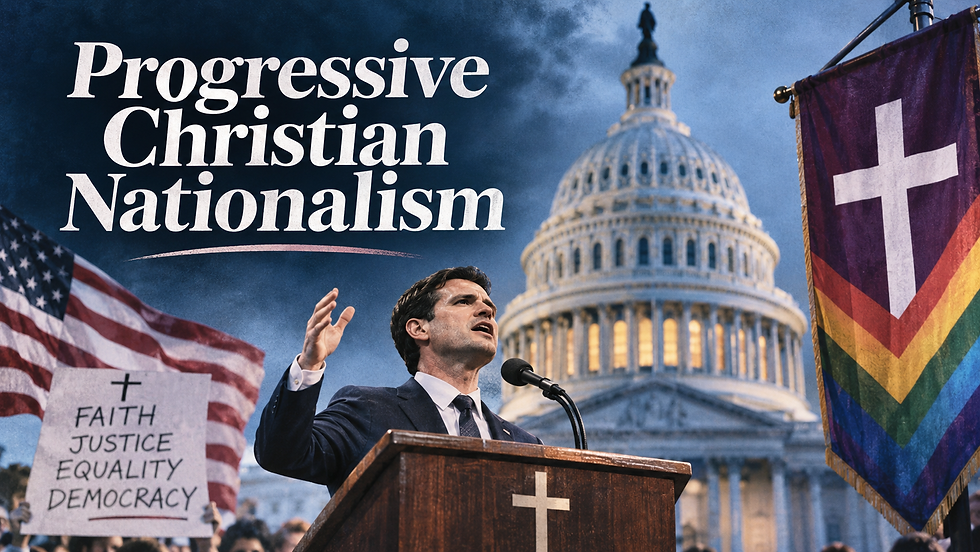
In May of 2024, I wrote an article arguing that Progressive Christianity has become the new cultural Christianity. On Tuesday, November 3rd, 2026, we saw the political fruits of that change. Democrats swept the House and the Senate and flipped multiple governorships amid a crashing Blue Tsunami.
Of course, there are many reasons for this, and my FTM colleagues and I recently hosted a live stream explaining some of them (Watch live stream HERE). Off-year elections often swing away from the party in power, and economic and national security factors played a part in Tuesday’s result. However, the full story is much more theological than one might first believe, and these results point to a more specific issue facing our churches and our country: something I call “Progressive Christian Nationalism.”
Off-year trends, the economy, and the war in Iran explain some of the blue wave, but they strain to account for normally conservative stalwart states like Texas and Kansas electing progressive Christians James Talarico and Adam Hamilton to the Senate. After the election, The Atlantic ran an article entitled “A Good Night for the Christian Faith,” in which the author, Peter Wehner, says: “Talarico and Hamilton are both committed and prominent Christians. They speak naturally about their faith, and their speeches and interviews are laced with scripture and biblical themes.” Wehner goes on to laud Talarico and Hamilton for the influence their faith has on their political convictions. The Forward likewise released an article entitled “Christianity won in the midterm elections — but not Christian nationalism.”
In his victory speech, James Talarico said, “Two thousand years ago, when the people at the top hurt his neighbors, that barefoot rabbi didn’t stay in his room and pray. He walked into the seat of power, and he flipped over the tables of injustice. … Texas, it’s time to start flipping tables.” This is an allusion to Jesus’s flipping of the tables in the temple (Matt 21:12–13; Mark 11:15–17; Luke 19:45–46). I want you to imagine, for a moment, that JD Vance says the same thing in a victory speech after winning the presidency in 2028. Would he be decried as a Christian Nationalist? I posit that he would. Talarico’s version of Christian Nationalism is more insidious, and yet more acceptable, because Progressive Christianity has become the new Cultural Christianity. Here, I will argue that Christian Nationalism comes, predominantly, in two forms. One uses the State as the church’s sword, the other as its altar, and the second is closer to being realized because no one is resisting it.
To be sure, far-right Christian Nationalism is a danger to the Church and to others. We at FTM found this so much to be the case that we departed from the term altogether. When I wrote “The Right Christian Nationalism” in November 2022, “Christian Nationalism” was a catch-all label, and I used it in its broad sense: Christian conservatism that sees America’s roots in the Christian faith and desires the nation to reflect them once again. That same month, Stephen Wolfe released The Case for Christian Nationalism, and over the following years Wolfe and voices like Joel Webbon filled the term with content we neither embraced nor intended. Webbon has argued that there is “no place” for non-Christians in American leadership, stating plainly that “Jews cannot hold public office,” and he has called for adding the Apostles’ Creed to the Constitution. This is no longer conservatism. It is a religious test for office and the coercion of confession, an approach that, as one Christian Post contributor put it, replaces faith with force. Once the term came to mean this, we let it go.
Opposition to this movement has come from across the spectrum. From the right, Kevin DeYoung, while sympathetic to the desire behind it, concluded that if Wolfe’s book “represents the best of that ism, then Christian Nationalism isn’t the answer” (TGC). Paul D. Miller called it a political theory “illiberal in theory and practice,” and Russell Moore described it as “a liberation theology for white people.” From the liberal side, Amanda Tyler of the Baptist Joint Committee told Congress it is “the single greatest threat to religious liberty in the United States today,” warning especially against religious tests for office. From the left, Katherine Stewart has described a movement seeking power to impose its vision on all of society, and sociologists Andrew Whitehead and Samuel Perry have built an entire research program around measuring it, a program we will return to. Whatever their differences, these critics share a core concern: the merging of Christian and American identity, religious tests for office, and coerced worship. On Webbon and Wolfe, they were right, and the church was right to reject them.
Amid the consternation, sociologists Andrew Whitehead and Samuel Perry, in their book Taking America Back for God, define Christian Nationalism as “a cultural framework—a collection of myths, traditions, symbols, narratives, and value systems—that idealizes and advocates a fusion of Christianity with American civic life” (pp. ix–x, 10). The definition is so vague that Christian apologist Neil Shenvi, in his review of the book, noted that by the authors’ own survey method, 38% of Democrats, 67% of Black Protestants, and even 21% of Jews come out as supportive of Christian Nationalism. A category that captures a fifth of American Jews isn’t measuring Christian Nationalism. Evangelical political scientist Mark David Hall reached a similar verdict, calling the concept “ill-defined” and noting that most of the literature criticizing it comes from activists with axes to grind.
The problem is built into the category: it is too broad when measured and too narrow when applied. The survey items largely measure support for establishment, such as declaring America a Christian nation, school prayer, and religious symbols in public spaces. So, the category sweeps in Black Protestants but exempts a seminarian who opposes all of those things while calling politics a sacrament. Little wonder that when David French praised James Talarico as an antidote to Christian Nationalism, Albert Mohler observed that “neither French nor Talarico bothered to define Christian nationalism.”
Consider a real case. Adam Hamilton, founding pastor of the largest United Methodist congregation in the country, was a lifelong Republican who was still a registered Republican at the beginning of 2026. He ran on his faith, quoted Scripture on the stump, and won. Same man, same faith, same rhetoric. Had the letter after his name been an R rather than a D, would he have escaped the label of Christian Nationalist? Unlikely.
What I seek to offer here is a better definition, one that encompasses both the Left and Right extremes of religiously driven politics. Christian Nationalism, properly defined, requires two conditions:
(A) The state takes on the church’s redemptive mission and becomes the primary instrument of Christ’s purposes.
(B) A partisan program becomes the content of Christian faithfulness, so that dissent from it counts as infidelity.
Both conditions are required. By “the church’s mission,” I mean its redemptive mission: proclaiming the gospel, administering the sacraments, and forming disciples. The state has its own God-given vocation of restraining evil and securing justice (Rom 13:1–7), and asking the state to do its job is not nationalism. Christian Nationalism begins when the state is asked to do the church’s job.
This form of Christian Nationalism comes in two primary species. The first is reactionary: the state as a Christian sword, enforcing an inherited Christian civic order. The second is progressive: the state as altar, with policy as a means of grace and inherited norms (marriage, sexuality, personal responsibility) dismantled in Christ’s name.
Consider how it sorts out the cases. Christian pro-life and civil-rights activists do not fit, and neither do abolitionists such as William Wilberforce. Neither does my colleague Dr. Tim Stratton, who has repeatedly indicated that a consistent and informed Christ-follower ought to oppose the evils of the democrat party. Each asked the state to restrain a grave evil, which is the state’s proper work. They would qualify only if they also made the state the instrument of redemption and made their platform a creed. A Jewish politician who believes America is divinely blessed does not fit either, since that is not a Christian political theology at all. Joel Webbon does fit as the reactionary species. Religious tests for office make the state the enforcer of confession (A), and the creed becomes a condition of citizenship (B). James Talarico, as we will see, fits as the progressive species.
Whitehead and Perry’s category gets the Jewish and civil-rights cases wrong and misses Talarico entirely. This definition sorts every one of them correctly.
Talarico is the litmus test for Progressive Christian Nationalism. He fits both conditions cleanly and overtly, but don’t take my word for it. Let’s examine Talarico in his own words.
Condition A. On The Ezra Klein Show, after listing progressive policy prescriptions on prescription drugs, childcare, and housing, Talarico said: “If we can infuse our politics with more of this spirituality, I think we could treat politics like a sacrament.” In other words, progressive policy becomes a means of grace. This is no throwaway line. Talarico describes politics and pastoring as “both… forms of ministry,” and when he had to choose between finishing his ordination and running for the Senate, he chose the campaign, explaining that it “does feel like we’re doing some kind of ministry.” For Talarico, “Christianity is both spiritual and political, because politics is really just another word for how we treat our neighbors.” And as noted above, his victory speech recast the temple as the seat of political power.
Condition B. Talarico does not merely argue for progressive policies; he makes them the measure of Christian fidelity. “You can’t call yourself a Christian and reject the stranger seeking asylum at our southern border.” Disagree with him on asylum policy, and your faith itself comes into question. His opponents, he says, are “baptizing their partisanship, and they’re calling that Christianity,” and “Christians in the halls of power are blatantly violating the teachings of Christianity on a daily basis.” Progressive policy is not argued on its merits. It is sacralized.
On this framework, the state, rather than the cross, becomes the soteriological mechanism. Talarico has said he loves “the trans children who showed up yesterday at the state Capitol to advocate for their humanity.” Notice the logic: humanity is something secured through political recognition at the Capitol. And why should any confession stand in the way? In a 2023 sermon, Talarico declared, “God is not a Presbyterian. God is not a Christian. God is not a noun at all.” Behind the Tillichian language of God as “being itself” lies a convenient conclusion: if God transcends Christianity, then no Christian confession has authority over the political program. Christianity becomes a means to a political end. Talarico admitted as much: “The reason I think Christianity can be powerful in our context in this country is because so many of our political opponents share that kind of, that tradition.” Some might wonder, how is this different than what you and Tim have espoused? The difference is clear. To Talarico, the Progressive Christian Nationalist faith serves the political priors rather than forming them.
To be fair, Talarico has real virtues. He opposes coerced faith, calling Ten Commandments mandates in classrooms “deeply un-Christian,” and he has said that “Jesus would [not] endorse the Democratic or Republican Party platforms.” He rejects the sword, and he rejects the party label. What he does not reject is the altar and, I would argue, this is much worse.
This view is captivating people in our own camp. David French, a longtime evangelical conservative, wrote that Talarico “is one of the few openly Christian politicians in the United States who acts like a Christian.” But a Christianity built on the niceness of being is not historic Christianity. It is progressive policy in a clerical collar, and grace has been redefined to government-subsidized self-actualization. The only real sin is that of conservative political power. This is why I recently called Talarico more dangerous than Mohamed El-Sayed. He wears the clothing of Christianity with the venom of progressive ideology, and he coats it with niceness to make the poison go down smoothly. And many Christians in Texas took the medicine without question.
The far right’s Christian Nationalism puts the law in the State’s hands and seeks to coerce righteousness; Progressive Christian Nationalism puts the gospel itself in the state’s hands, offering redemption through policy. Both commit the same fundamental error: they collapse the two kingdoms, only in opposite directions. Scripture gives the state the sword to restrain evil (Rom 13:4), and it gives the church the Word and sacraments to redeem. The reactionary makes the state the church’s enforcer. The progressive makes the state the church’s altar.
I am not the first to notice this similarity. Russell Moore, no friend of the far right or the conservative right, observed that the new Christian Nationalism, “like the withered old state churches of Europe and the secularized old social gospels of mainline Protestantism,” defines Christianity by “reforming external structures rather than regenerating internal psyches.” Moore once called right-wing Christian Nationalism “a liberation theology for white people.” I would argue that its progressive counterpart is simply liberation theology with better branding.
Nor is this a new concern for me. In 2022, I wrote that the Christian Nationalism I find abhorrent is “the kind that seeks to dogmatize patriotism as a sacrament.” Four years later, a senator-elect has proposed that we “treat politics like a sacrament.” The danger I named then has arrived, only from the other direction.
And here is why the progressive version is closer to being realized. The reason is not that it is more extreme. Joel Webbon has a podcast. James Talarico has a Senate seat. Webbon is marginal, and he has been named and condemned across the spectrum, by DeYoung, by Moore, and by the Christian Post. Talarico is celebrated as the cure. Over the last decade, the church has developed antibodies to the sword. It has not yet developed them to the altar, and the infection is festering within the American Church.
So, the choice before Christians is not between Joel Webbon and James Talarico. Neither represents historic Christianity. One wields the faith as a sword, and the other offers politics as a sacrament. The problem beneath both is formation. As Alan Jacobs told Peter Wehner, “This is true of both the Christian left and the Christian right… People come to believe what they are most thoroughly and intensively catechized to believe, and that catechesis comes not from the churches but from the media.” If cable news and podcasts catechize our people, they will come out reactionary or progressive, and in neither case orthodox. The remedy is discipleship, and that starts in our own congregations.
Our Churches must recognize and teach the difference between the two kingdoms again. The state bears the sword to restrain evil (Rom 13), and we participate in that restraint as we vote. We also have a duty to name and expose the deeds of darkness (Eph 5:11) as part of this restraining process. The Church, however, bears the Word and sacraments to redeem. Christians should, of course, care deeply about both, but we should never confuse them.
Pastors and elders must not refrain from addressing seemingly political issues from the pulpit, and they must teach and disciple their congregations in the difference between the Church and State. We must guard the sacraments as the church’s! Grace comes through Christ, and him alone, not through the ballot box or the legislature. A congregation rightly discipled to understand what a sacrament is will not be seduced by a politician who promises to make politics one.
If progressive Christianity is the new cultural Christianity (as I argued two years ago), then it should come as no surprise that such a dangerous political ideology would be mistaken as “truly Christian” by the people in our pews. We must recognize that the rise of Progressive Christian Nationalism did not come out of nowhere. We must come to grips with the fact that many people who come and sit in our pews (or chairs) have adopted some form of this ideology without realizing it.
Just as it is important to counsel our people away from the far-Right Christian Nationalism, we must do the same in opposition to Progressive Christian Nationalism.
Finally, we must love our neighbors through the church before we seek the State to do it for us. We must teach our people that caring for the poor, the stranger, and the vulnerable is a church mandate, and we must not abdicate such responsibility to the state; furthermore, we must insist that the State take the church’s place in this endeavor.
Talarico was right about one thing: Jesus overturned the tables. But he did in the temple, to restore it as “a house of prayer” (Matt 21:13), not to move it to the seat of power.
The danger of both nationalisms is in the moving of the altar. The calling of the church is to keep it where Christ put it.



Comments