
What is the Gospel?

Updated: Oct 29, 2025
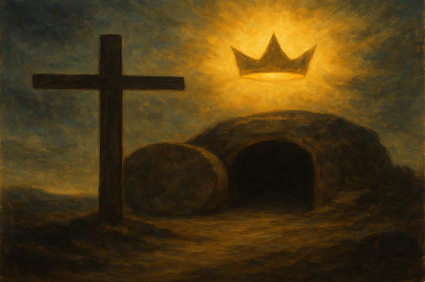
Due to recent events, the world has been shaken. The various murders, and specifically the assassination of Charlie Kirk, have left many Americans with questions of justice, the future, and truth. Our world has never seemed so dark, and the divide in America has never seemed so wide. Yet despite the horror and darkness of the past few weeks, hope is on the horizon. Revival. Never, in recent years, has the Church had such a potential harvest laid at our feet. God is truly turning evil to good with millions of Americans returning to church for the first time. (Gen 50:20)
If revival is coming, we must be ready. We need to be prepared for the harvest. (Luke 10:2) But how do we prepare? What is our greatest tool? The Gospel. Why is the Gospel so important? “It is the power of God for salvation” (Rom 1:16)
Hearing and responding to the Gospel in faith is how we enter into God’s kingdom, making it the most important message one can hear. If we want to fan the flames of revival, it is vital that we know the Gospel fully so that we can share it with those who need it.
So what exactly is the Gospel? I argue that, in general, the Gospel has eight essential parts, nine if you include the foundation; that the subject of the Gospel is Jesus and the Kingdom of God.<1>
The Gospel
Jesus:
Jesus is the foundation of the Gospel. The entire Gospel revolves around him. The four gospels Matthew, Mark, Luke, and John, are centered around the man who is Jesus of Nazareth.<2>
Is the Christ (Messiah-King)
The first fact that must be understood about Jesus is that he is the Christ. Christ is not a last name, but rather a title. The title Christ labels Jesus as the Jewish Messiah, the anointed one, the long-awaited King. In his gospel, John tells his readers that this gospel was written to convince them that “Jesus is the Christ, the Son of God”. (John 20:31) Each gospel labels Jesus as the Christ, the Messiah.<3>
Jesus being the Christ is essential to the Gospel. Jesus himself proclaimed the Gospel that the kingdom of God is near.<4> If there is a kingdom, there is a king. That king is the Christ, the Messiah, making Jesus the king of the kingdom of God. (1 Timothy 1:10) We can also know his title as Christ is important, because in every Gospel presentation, he is named as Jesus Christ, or Christ Jesus (or any other variation).
Was sent by God the Father
Jesus’s close connection to God the Father is found in every gospel and is what gives authority to Jesus’s ministry. In Matthew’s gospel, Jesus states,
“All things have been handed over to me by my Father, and no one knows the Son except the Father, and no one knows the Father except the Son and anyone to whom the Son chooses to reveal him.” (Matt 11:25)<5>
Jesus makes several statements indicating that he was sent by God for a purpose. John 3:16 “ that he gave his only Son” is a clear example. Jesus mentions the Father sending him again in John 5:24, “whoever hears my word and believes him who sent me has eternal life”.
Took On Human Flesh
How was Jesus sent? What was his arrival like? Jesus came through the virgin birth, taking on the form of a man. John gives one of the clearest statements of God becoming man in John 1:14, “And the Word became flesh and dwelt among us”. As John clearly states at the beginning of the chapter, “the Word was with God, and the Word was God.” (John 1:1) The Word is later identified as Jesus. One only needs to look at the birth stories found in the other gospels to see a clear image of Christ coming in human flesh.
Looking beyond the four gospels, Paul also confirms that God, the Son, took on humanity. Paul writes in a hymn that Christ took on “the form of a servant, being born in the likeness of men”. (Phi 2:6-7) In having Christ take on human form, God has revealed himself to us. Christ is the ultimate image bearer of God.<6> We cannot perfectly bear God’s image as Christ can.
Willingly Died for the Sins of Mankind
There are three important parts of Christ’s death. One is that Christ willingly died for mankind. Matthew writes that Jesus, though asking the Father if there was another way, was willing to obey the Father’s will to go to the cross. (Matt 26:39)<7> In John’s gospel, Jesus mentions his upcoming death many times. He even states that his soul is troubled, but because he came for this purpose, he will not turn away from it. (John 12:27)
The second part is that Christ actually died. Every gospel mentions his death on the cross in clear terms.<8>Every time the Gospel is preached, Christ’s death is mentioned.<9> In 1 Corinthians 15, Paul retells the Gospel, and the first part he mentions is that “Christ died”. (1 Cor 15:3) We find this also in Acts during Peter’s first sermon after the ascension of Christ, after Pentecost. Peter tells the crowd that Jesus was crucified and killed as part of the plan of God. (Acts 2:23)
The third part pertaining to Christ’s death is that he died for the sins of mankind. His sacrifice for sins is typically mentioned in tandem with his death. Paul writes that “Christ died for our sins”. (1 Cor 15:3) Though sins are not explicitly mentioned, Jesus says in two of the gospels that he is dying for mankind. Matthew quotes Jesus as saying that he came “to give his life as a ransom for many.” (Matt 20:28)<10>
Was Buried
At first glance, his burial may look like a minor point, but it gives evidence of his physical death. His burial is mentioned in every gospel after the crucifixion narratives.<11> Paul mentions it when he retells the Gospel to the Corinthians, “that he was buried”. (1 Cor 15:4) Paul also mentions Christ’s burial in Colossians to show the connection between our baptism with the form of Christ’s life. (Col 2:12)
Was Resurrected by God
Just as the death of Christ is essential to the Gospel, so also is his resurrection. After all, as Paul wrote, “if Christ has not been raised, then our preaching is in vain and your faith is in vain.” (1 Cor 15:14) If Christ was not raised from the dead, then our faith is false. Christianity is false. This is a major reason why his resurrection is so important.
All four gospels write about his resurrection, with John’s gospel giving the most information about his post-resurrection appearances.<12> Christ’s resurrection is actually mentioned more than his death, demonstrating the importance of his resurrection to the Gospel.<13>
Ascended Into Heaven at the Right Hand of the Father
The ascension, though important, is an often-neglected part of the Gospel. Many often end the Gospel message at the resurrection, but the importance of the ascension cannot be emphasized enough. Two of the gospels mention his ascension at the end of their narrative, often after he gives a commission to his disciples.<14> Luke also describes the ascension of Christ in Acts, just before the event at Pentecost. (Acts 1:6-11)
During his earthly ministry, Jesus himself foretells his ascension back into heaven at the Father’s side.<15> Paul also mentions the ascension of Christ. He writes, “Therefore God has highly exalted him and bestowed on him the name that is above every name”. (Phi 2:9) His ascension back into heaven is his exaltation. God exalted him and gave him the throne. (Matt 26:64) His ascension indicates the success of his work on earth, and it inaugurates his kingly reign. When Paul retells the Gospel in Romans 1:3-4, Christ’s ascension, that is, his enthronement and declaration as the Son of God, is the climax.<16>
The apostles emphasize this in their sermons in Acts. Peter mentions several times within the first several chapters.<17> What is also neglected about the ascension is that it is only because Jesus is now king that he can “give repentance to Israel and forgiveness of sins”. (Acts 5:31) As king and Lord, Jesus has the ultimate authority to forgive sins.
Will Return as Judge
Now that Christ is the reigning king, the final part of the Gospel is his second coming as Judge. Jesus tells of his second coming and the future judgment. Matthew writes,
“When the Son of Man comes in his glory, and all the angels with him, then he will sit on his glorious throne. Before him will be gathered all the nations, and he will separate people one from another as a shepherd separates the sheep from the goats. And he will place the sheep on his right, but the goats on the left.” (Matt 25:31-34)
The end of the book of Revelation speaks of this judgment. John quotes Christ as saying, “Behold, I am coming soon, bringing my recompense with me, to repay each one for what he has done.”
Peter also preaches about this. In teaching Cornelius, he tells him that Jesus has been appointed by God to judge the living and the dead. (Acts 10:42) As the reigning king, Jesus has the authority to judge all of mankind. It is this judgment that will result in the final destination of every person. Those who are in Christ will be with him forever, and those who oppose him will be cast into the lake of fire.
Conclusion
The Gospel is all about King Jesus and the work he has done and will do. King Jesus has come, by the Father’s will, to die for the sins of mankind. He was raised back to life from God, as vindication of his ministry, ascended back into heaven, and is now reigning on the throne of God as our King and Judge.
There is a revival coming. We need to know the Gospel. Whether you use this summary of the Gospel or read the gospels until you know the story by heart, we need to be able to teach it at a moment’s notice. For it is not only our responsibility to give our allegiance to King Jesus, but to spread his Gospel far and wide, giving all people the chance to give their allegiance.
Bibliography
Bates, Matthew W. Gospel Allegiance. Grand Rapids: Baker Publishing Group, 2019.
<1> My work here was inspired by Matthew Bates’s work in his book Gospel Allegiance. Though my parts do not conform exactly with his own summation of the Gospel, his structure did influence mine. Matthew W. Bates. Gospel Allegiance. (Grand Rapids: Baker Publishing Group, 2019), 86-87.
<2> Matt 1:1; Mark 1:1; Acts 1:1; John 20:30-31
<3> Matt 1:1, Mark 1:1, Luke 4:41
<4> Matt 4:23; Mark 1:15
<5> Also found in Luke 10:22
<6> 2 Cor. 4:4; Col 1:15
<7> This same prayer is mentioned in both Mark and Luke. (Mark 14:36; Luke 22:42)
<8> Matt 27:45-50; Mark 15:33-37; Luke 23:44-46; John 19:28-30
<9> Rom 1:4; Col 1:18, 2:13-14; Phi 2:8; Heb 2:14-17
<10> This saying is also found in Mark. (Mark 10:45)
<11> Matt 27:57-61; Mark 15:42-47; Luke 23: 50-56; John 19:38-42
<12> Matt 28:1-10; Mark 16:1-8; Luke 24:1-12; John 20:11-18
<13>Bates, 95.
<14> (Mark 16:19-20; Luke 24:50-53)
<15> John 6:62, 7:33-34, 20:17; Luke 24:49
<16> Bates, 97.
<17> Act 2:33, 5:31, 7:56


Comments