
WHERE DOES MORALITY COME FROM?: Stratton vs Suttles Debate

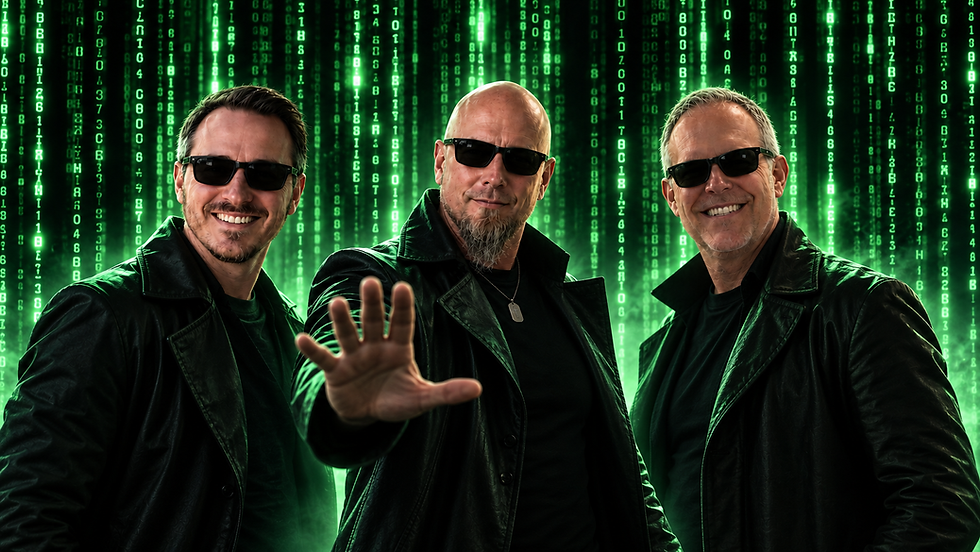
Here's my opening speech from my second debate with my good friend Richard Suttles. To watch the entire debate, click here. To watch our first debate, click here.
What follows are my actual speaking notes from the debate. So, you'll see my cues for slowing down and pausing, along with highlighted words and phrases I wanted to make sure I emphasized or didn't miss. I've also included several of the PowerPoint slides I used during my opening presentation.
Stay reasonable (Isaiah 1:18),
Tim
Good evening!
First, I want to thank my two favorite Richards.
I sincerely mean this: both of these guys are dear friends. If it weren’t for Richard Eng, FreeThinking Ministries would not exist . . . but that's a conversation for another time.
Richard Suttles . . . you have become such a good friend that I sometimes forget you're not my brother in Christ . . . at least not yet! 😉
Richard loves his wife and kids, loves his neighbors, and even loves those who consider him an enemy. I know he loves me like a brother.
Now, I suspect that by the end of this evening, something interesting is going to become apparent:
Richard and I probably agree about a whole bunch of morality.
We both think murder is wrong. We both oppose cruelty. We both care deeply about human flourishing, kindness, justice, and the kind of world our children inherit.
So let me make something crystal clear from the outset:
My argument tonight is NOT that atheists or agnostics cannot be good people or recognize moral truths.

Of course they can!
Tonight's question goes much deeper . . .
Where Does Morality Come From?
But we need to distinguish two questions: (i) Where did our moral beliefs and behaviors come from? And (ii) what explains the objective moral truth those beliefs are supposed to track?
Tonight, I'll argue that objective morality is real . . . and that Christian theism provides a powerful explanation of why.
That's the issue.
So let's begin by getting clear about our terms.
What Do We Mean by "Objective Morality"?
When I say something is objectively morally wrong . . . I mean that it is wrong independently of what any human being—or group of human beings—happens to think about it.
Consider the Holocaust.
Suppose Nazi Germany had won World War II. Suppose Hitler had conquered the world.

Suppose every person who disagreed with Nazi ideology had eventually been killed or brainwashed.
And suppose that after several generations, every human being left on Earth sincerely believed that exterminating Jews was morally good.
Would the Holocaust suddenly become morally good?
Of course not! It would still be wrong and evil.
And that tells us something enormously important . . . Human opinion does not determine moral reality.
Votes don't determine it . . . Governments don't determine it . . . Cultures don't determine it. Evolutionary impulses don't determine it . . . And our personal opinions and preferences don't determine it.
Indeed, that's precisely what the Nazis argued at Nuremberg.

They essentially said: "But we were just following German law."
And the response of Chief Justice Jackson and the international tribunal was essentially:
“There is a law above your law!”
Think about that. If morality is merely social convention, what gave the Allies objective moral authority to condemn the Nazis? German society had its laws; America had ours. But we don't merely say, “I personally dislike the Holocaust.”
We say: THE HOLOCAUST WAS EVIL—even if Hitler had won.
Here's a simple argument:
If the Nazis were properly convicted at Nuremberg, then there is an objective moral law above human law.
The Nazis were properly convicted at Nuremberg.
Therefore, there is an objective moral law above human law.
And I think we all know it's true . . .
In fact, I would argue that moral reality is, in an important sense, more certain than the physical world around us.
Think about that really old movie . . . The Matrix.
Maybe everything I'm experiencing right now as physical reality is just a sophisticated computer simulation. Maybe this podium doesn’t really exist—it's logically possible.
Now compare that with this proposition: “It is wrong to torture a toddler for fun.”
Could scientists announce tomorrow, “Good news! We've discovered that torturing babies for entertainment is morally wonderful!”
No!
Even if this podium does not really exist—it’s just an illusion . . . torturing a toddler for fun is still objectively wrong.
That's how certain we are that objective morality is real—we’re more certain of moral reality than we are of physical reality.
So the interesting question tonight isn't whether objective morality exists. It's: What explains it?
Moral Beliefs Are Not Moral Truth
I suspect Richard will have fascinating things to say about evolution, biology, cooperation, empathy, and human flourishing. And those things might help explain how humans developed moral beliefs.
I'm a Christian. I'm not remotely threatened by the possibility that God used evolutionary processes in developing human beings. In fact, I discuss this in chapter 16 of the second edition of my book Human Freedom, Divine Knowledge, and Mere Molinism.
But explaining why we BELIEVE something is morally true does not explain what MAKES it true.
Suppose evolution had produced creatures with an overwhelming instinct to kill disabled infants. Would that make infanticide objectively good? . . . Of course not.
Evolution might explain moral beliefs. We're asking what explains moral truth.
Flourishing Doesn't Solve the Problem
Perhaps we'll hear that morality should be understood in terms of human flourishing.
Human flourishing sounds great to me! I'm all for it. But WHY is human flourishing objectively good?
If flourishing makes us happy, why am I objectively obligated to promote someone else's happiness? If cooperation helps societies survive, why is survival objectively morally good?
And if flourishing just IS objectively good . . . then we haven't explained it.
The question remains: WHY is there an objective way human beings ought to live at all?
Moral Purpose
I want to talk about purpose.
Suppose atheistic naturalism is true.
There is no God . . . The universe exists without intelligent intention behind it . . . Humanity is ultimately the accidental consequence of mindless, non-rational, and non-moral physical processes.
Then what objective purpose does humanity possess?
I don't mean subjective purpose.
Of course we can invent subjective purposes. I can decide my purpose is to write books.
Richard can decide his is to be the coolest atheist in the world. . . Hitler can decide his purpose is to kill Jews.
But I'm asking a much bigger question: What are human beings FOR? What is our objective purpose?
Because here's the problem: If there is no objective purpose for human beings, then there cannot be an objective way human beings ought to live in order to fulfill that purpose.
Think about a knife . . . It's designed to cut. That's why we can meaningfully call one knife good and another bad relative to its purpose.

It’s why it’s objectively stupid to use a hammer to cut your steak—it’s the objectively wrong tool for the job.
But if human beings are unintended accidents of nature, there is no mind behind humanity intending us for anything. We simply are.
And that makes objective moral obligation mysterious.
This leads into what I have called the Ultimate Moral Argument. Consider three ingredients of a robust moral worldview:
· Purpose.
· Power.
· Punishment.
Or more philosophically: objective moral purpose, libertarian control, and ultimate accountability.
We've already considered the first: objective purpose.
Christian theism provides a straightforward answer. Human beings exist intentionally. We were created on purpose—and for a purpose.
And Jesus summarizes that purpose beautifully:
Love God and love your neighbor.
He even tells us to love our enemies!
Indeed, I would argue that if Christianity is true, then . . . humanity's objective purpose is to love all persons—from each person of the Trinity to each person the Trinity created.
That’s your neighbor.
Christianity therefore doesn't merely tell us that love happens to be useful . . . It tells us that love is connected to what human beings are actually for.
But if there is no God and humanity is the unintended and accidental result of mindless stuff . . . what objective purpose does humanity have?
Nothing!
Bottom line: if atheistic naturalism is true, human beings are ultimately the accidental result of mindless physical processes. So what makes us objectively more valuable than cancer cells?
On Richard’s atheistic view, humanity was not created on purpose or for any purpose.
But if Jesus was right . . . humanity was created on purpose and for the purpose of love.
Therefore, you OUGHT to be loved—and when you are not loved, it is objectively wrong and evil.
Which, by the way, is what grounds the objective and unalienable human rights Richard has devoted his life to protecting.
This leads us to my second point . . .
Genuine Control
Suppose naturalistic determination is true.

If Hitler's brain chemistry, genetics, environment, and prior physical states causally necessitated everything he thought and did, then he was another domino in an unimaginably long chain of physical causes.
On that picture, the Holocaust begins to look less like something for which rational agents are ultimately responsible . . . and more like a horrific natural disaster.
We don't morally blame hurricanes. WHY? Because they don't possess rational control.
Christian theism has room for something much richer: libertarian freedom—genuine rational control such that, at least in morally significant circumstances . . . we could do otherwise. (as described in 1 Cor 10:13).
That makes praise and blame intelligible.
Ultimate Accountability
Imagine two men . . .
One spends his life serving the poor, loving his family, and sacrificing for others. The other spends his life torturing puppies, kittens, and human toddlers and also committing genocide.
Then both die.
If atheism is true, ultimately, what happens? Both return to dust. Eventually humanity disappears, the universe reaches its final physical state of heat death, and there is no final judgment. No one will remember their names or anything they did.
No ultimate justice. No final reckoning . . . The universe simply does not care.
But Christianity says something radically different. Persons matter ultimately, so our moral choices NOW matter ultimately. Death is not the end of the story. There is a final judgment, and justice ultimately matters.
So Christianity gives us a coherent picture:
Objective purpose.Genuine moral freedom.Ultimate accountability.
Purpose.
Power.
Punishment.
The Ultimate Moral Argument
This brings us to what I call the Ultimate Moral Argument.
Let me put it deductively . . .
1. If God does not exist, then humanity is an accident of nature and completely determined by nature.
2. If humanity is an accident of nature and completely determined by nature, then there is (i) no objective purpose to human existence, (ii) humans have no genuine control over their behavior, and (iii) there is no ultimate moral accountability for human behavior.
3. If humanity lacks objective purpose, OR genuine control, OR ultimate moral accountability, then objective moral obligations are illusory.
4. Objective moral obligations are not illusory.
We've already seen why. Chief Justice Jackson was right: there is a Law above human law—a law the Nazis ought to have obeyed and had the power to obey, but they failed.
5. Therefore, there is (i) an objective purpose to human life, (ii) humans have genuine control over their behavior, and (iii) there is ultimate moral accountability for human behavior.[1]
6. Therefore, humanity is not an accident of nature and completely determined by nature.
7. Therefore, God exists.
Here’s the big questions: Which premise does Richard reject—and why?
Wherever Richard thinks this argument goes wrong, that's exactly where our discussion should take place tonight.
But notice what won't refute this argument: showing that atheists behave morally, that Richard and I share moral intuitions, that cooperation provides evolutionary advantages, or that humans flourish when we treat one another well.
I already believe all of that. None of it tells us which premise of the argument is false.
In fact, suppose Richard and I both want a world that is something like Little House on the Prairie.
We both want Walnut Grove! . . . Fantastic.
But the philosophical question tonight isn't whether Richard wants Walnut Grove while I want Mordor (from The Lord of The Rings).
The question is: Is Walnut Grove actually morally better than Mordor?

And if everyone on Earth suddenly preferred Mordor . . . would Mordor suddenly become morally good?
If the answer is no, then morality transcends human preference.
And if morality transcends our behavior and preferences, we still need an explanation for the moral reality they're supposed to track.
What Would Explain All of This?
Now consider the explanatory power of Christian theism.
Suppose there exists a Maximally Great Being . . . a necessarily existent, perfectly good, perfectly loving, perfectly rational Mind who created human beings intentionally and endowed them with genuine moral freedom.
Suddenly the pieces fit together.
Persons possess objective value because they are intentionally created and loved by the ultimate Person—the ultimate MIND behind the universe!
Human beings possess objective purpose because we were created on purpose and for a purpose.
We are morally responsible because we possess genuine rational freedom and control to choose to live according to that objective purpose or not.
And moral obligations have authority because they are grounded in the nature, character, and creative intent of a perfectly wise and loving Creator.
Now compare that with atheistic naturalism: no mind behind the universe, no intention behind humanity, no objective purpose for our existence—and moral intuitions produced by evolutionary forces aimed at survival and reproduction.
Yet somehow, floating above this mindless, purposeless reality are objective moral facts declaring: (say with sarcasm) . . .
“You ought to love your neighbor”?
Why?!? . . .
Why should mindless, non-rational, and non-moral stuff generate moral obligation?
Why should accidental creatures possess objective purpose? Why should survival equal goodness or flourishing generate obligation?
Maybe Richard has answers. I look forward to hearing them . . . But shared moral preferences won't answer the question.
Conclusion
So tonight, whenever Richard and I agree that something is good, I want you to remember one question:
What makes that objectively true?
Richard says compassion is good? Great! . . . What makes that objectively true?
He says unnecessary suffering is bad? Absolutely! . . . What makes that objectively true?
That IS the debate.
Look . . . I already know that Richard is a good man.
The question is whether atheistic naturalism provides an adequate foundation for the objective moral reality that Richard and I both recognize.
Christian theism says that behind moral reality stands a necessarily existent, perfectly good, loving, and rational Mind.
Purpose. . . Power. . . Punishment.
Objective moral purpose . . . Genuine moral freedom . . . Ultimate moral accountability.

Those three ingredients don’t fit within an atheistic worldview . . . but they make perfect sense of the worldview Jesus revealed.
Thank you.
Notes
[1] This follows based upon modus tollens and De Morgan's law. If the absence of any one of those three is sufficient for moral obligations to be illusory, and moral obligations are not illusory, then none of the three can be absent. Therefore, all three are present.
Think about three light switches.
Suppose I say: “If ANY ONE of these three switches is OFF, the machine won't work.”
Then I tell you: “The machine is working.”
What can you conclude? Every switch must be ON.


Comments